
The architectural landscape of late-Victorian and Edwardian British cities is anchored by a quiet, foundational tension: the structural balance between rapid industrial modernization and classical aesthetic permanence. Few artists navigated this delicate intersection as successfully, yet remained as personally anonymous to the public, as the British sculptor Frederick William Pomeroy. As a principal vanguard of the New Sculpture movement, Pomeroy shifted the trajectory of British public monuments away from rigid, formulaic neoclassicism toward a dynamic, breathing naturalism rooted in deep anatomical realism and tactile fluid mechanics. His legacy stretches from the high-altitude engineering challenges of the London skyline to the sprawling civic pride of Edwardian Belfast, showcasing an extraordinary ability to marry fine art with complex structural execution. [1, 2, 3]
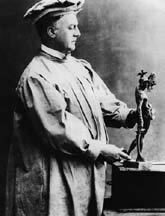
Early Hardship, Apprenticeship, and Academic Achievements
Frederick William Pomeroy was born on October 9, 1856, in the working-class industrial district of Lambeth, Surrey (now part of greater London). He was the son of Charles Pomeroy, a skilled artist-craftsman and stone mason whose daily work brought him into direct contact with the demanding physical textures of architectural construction. This familial lineage of manual craft deeply shaped the young Pomeroy’s lifelong relationship with raw materials. However, the domestic stability of his youth was shattered around 1869 when his father passed away unexpectedly. At just fourteen years of age, Pomeroy was suddenly cast as the principal breadwinner for his family. [4, 5]
Rather than fleeing his father’s grueling trade, Pomeroy leaned into it out of financial necessity, apprenticing to a firm of commercial architectural carvers. This early immersion in structural masonry provided him with a rigorous, unsentimental understanding of material physics, chisel dynamics, and structural load-bearing capacity—practical engineering skills that many university-educated sculptors of his era lacked. [6]
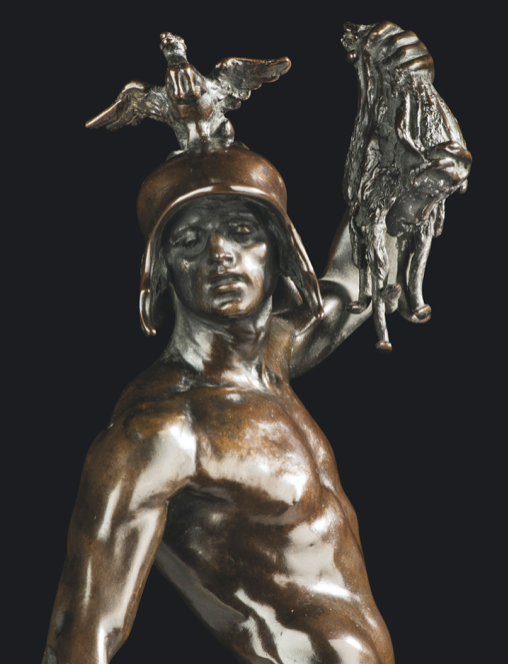
Seeking to elevate his mechanical aptitude into fine art, Pomeroy enrolled in classes at the South London Technical Art School (also known as the Lambeth School of Art). Here, he studied in the modelling class under the highly influential French sculptor Jules Dalou, whose emphasis on naturalistic modelling and expressive form left an indelible mark on the young Englishman. Pomeroy’s technical precision earned him admission into the prestigious Royal Academy Schools in London, where he studied from 1881 to 1885. His tenure at the academy culminated in 1885 when he won both the highly coveted Royal Academy Gold Medal and a traveling scholarship. [4, 6]
This scholarship provided him with vital continental exposure, allowing him to travel extensively through the artistic hubs of France and Italy. In Paris, Pomeroy embedded himself under the master sculptor Antonin Mercié, observing the expressive, emotive methods of contemporary French realists. Following further studies in Rome, Pomeroy returned to London to embark on his independent professional career. [4, 5, 6]
                     [F.W. Pomeroy Training Timeline]
                                     |
    Apprenticed to Architectural Carvers (Following Father's Death)
                                     |
    [Late 1870s] Studied under Jules Dalou at Lambeth School of Art
                                     |
    [1881-1885] Enrolled at Royal Academy Schools (Gold Medal & Travel Scholarship)
                                     |
    [1885-1886] Studied under Antonin Mercié in Paris, followed by Rome
Rise within the New Sculpture Movement
Upon establishing his London studio, Pomeroy quickly aligned himself with the ideological vanguard of his generation: the New Sculpture movement. This late 19th-century artistic rebellion sought to dismantle the stiff, idealized, and lifeless marble conventions of early Victorian neoclassicism. The New Sculptors demanded a return to flesh-and-blood naturalism, intricate psychological expression, and a renewed focus on the complex, fluid process of bronze casting using the cire perdue (lost-wax) method. [1, 3]
Pomeroy’s technical capacity caught the attention of the movement’s spiritual leaders. In 1891, he was commissioned to execute a highly demanding, full-scale carved marble replica of Frederic Leighton’s foundational masterpiece, Athlete Wrestling with a Python, which was widely viewed as the catalyst of the entire New Sculpture style. While working on this complex replication, Pomeroy began exhibiting his own ideal mythological works at the Royal Academy Summer Shows and the Arts and Crafts Exhibition Society, having joined the Art Workers’ Guild in 1887. Early pieces like So on a Delphic Reed (1888), the sensual bronze Dionysus (1890), and Love the Conqueror (1893) won him immense artistic acclaim and established his reputation as a master of the human form. [3, 5, 7]
Engineering Lady Justice: The Blueprints of the Old Bailey
Pomeroy firmly believed that high art should not be confined to private aristocratic collections but should actively decorate the public buildings, bridges, and municipal spaces inhabited by everyday citizens. This philosophy transformed him into a highly prolific architectural collaborator, working hand-in-hand with leading architects like Arthur W. Blomfield, Alfred Waterhouse, John Belcher, and E. W. Mountford. [5, 7]
This collaborative expertise met its ultimate execution between 1905 and 1906, when Mountford selected Pomeroy to execute the crowning icon of London’s new Central Criminal Court, the Old Bailey. Pomeroy’s task was to create a monumental allegorical figure of Lady Justice that would sit atop the copper dome, completely exposed to intense weather conditions. [1]
The physical reality of executing a colossal figure at an altitude of nearly 200 feet required precise material metrics. Fabricated by the renowned J.W. Singer and Sons foundry in Frome, Somerset, the monument features specific dimensions:
- The Statue: Stands exactly 3.65 meters (12 feet) high.
- The Globe: Measures 1.5 meters in diameter at her feet.
- The Sword: Measures 2.3 meters in length.
- Total Weight: Weighs approximately 22 tonnes.
To withstand the intense wind loads sweeping across the open London skyline, Mountford and Pomeroy developed custom structural blueprints. The statue was cast in a series of hollow, interlocking gilt-bronze segments. Rather than relying on the outer bronze shell for stability, the structural integrity of the monument depends on a massive internal steel armature tie-bar. This internal structural skeleton runs vertically through the core of the figure, enters through the sole of the statue’s foot, passes through the center of the bronze globe, and extends deep into the structural brickwork of Mountford’s masonry dome below. This tie-bar anchors the dead weight of the statue directly into the foundational framework of the building, allowing her to hold her heavy sword and balance scales aloft without risking structural fatigue.
Defying standard classical iconography, Pomeroy intentionally chose not to blindfold the figure. Historical court records note that her open eyes were intended to symbolize a justice that is clear-sighted, vigilant, and inherently impartial, rendering a blindfold entirely redundant.
Major Civil Works: Vauxhall Bridge and Glasgow Green
Pomeroy’s secular reliability as a contractor who understood the structural needs of massive public works brought him numerous commissions from municipal governments. [7]
When the London County Council reconstructed the Vauxhall Bridge across the River Thames, Pomeroy was selected alongside sculptor Alfred Drury to execute the colossal bronze allegorical figures lining the bridge’s structural masonry piers. Pomeroy executed four of the bridge’s eight massive statues, casting heavy bronze figures that explicitly represented Agriculture, Architecture, Engineering, and Civil Science. His figure of Architecture holds a miniature model of St Paul’s Cathedral, highlighting his deep respect for structural design. [7]
Earlier in his career, Pomeroy demonstrated an adeptness with alternative mediums. In 1887, he executed a massive terracotta figure of Australia for the grand Victoria Fountain on Glasgow Green. Commissioned and donated by the famous porcelain manufacturer Sir Henry Doulton, this intricate public fountain required Pomeroy to model clay details that could withstand industrial kiln firings while retaining the sharp naturalistic drapery characteristic of the New Sculpture style. [7]
               [F.W. Pomeroy's Core Public Portfolios]
                                  |
     +----------------------------+----------------------------+

     |                            |                            |
[London Works]             [Belfast Works]             [Regional Works]
 - Lady Justice             - City Hall Pediment        - Terracotta Australia
   (Old Bailey, 1905)         (Hibernia & Commerce)       (Glasgow Green, 1887)
 - 4 Colossal Bronzes       - Lord Dufferin Memorial    - Robert Burns Statue
   (Vauxhall Bridge, 1905)    (Bronze & Granite, 1906)    (Paisley, 1894)
 - Gladstone Statue         - Sir James Haslett         - Dean Hook Monument
   (House of Commons)         (Merchant Bronze)           (Leeds, 1901)
Imperial Modernity: The Belfast Municipal Commissions
Pomeroy’s reputation as a punctual, elite architectural contractor made him highly sought after during the peak of the Edwardian industrial boom in Belfast, Northern Ireland. When architect Sir Brumwell Thomas designed the monumental, Classical Renaissance-style Belfast City Hall, Pomeroy was commissioned to decorate its exterior facade, transforming the city’s main public square into an artistic statement of civic pride and industrial might: [1]
- The Main Pediment (1906): High above the main northern entrance of Belfast City Hall, Pomeroy sculpted a massive stone pediment group. At the center stands Hibernia, the patron goddess of Ireland. Flanking her is the Roman goddess Minerva, accompanied by personified figures of Labour, Industry, Liberty, and Commerce. Reflecting Belfast’s status as a global manufacturing powerhouse, Pomeroy carved these allegorical figures holding the real-world instruments of local wealth: harps, torches, spinning wheels, and detailed bolts of Irish linen. [7]
- The Lord Dufferin Memorial (1906): Erected on the manicured lawns of City Hall, this grand bronze and granite monument pays tribute to Frederick Temple Hamilton-Temple-Blackwood, the Marquess of Dufferin and Ava. Pomeroy housed the statue of the local diplomat within an ornate stone canopy that serves as a miniature version of City Hall itself. At the base of the monument, Pomeroy sculpted two striking guardian figures to represent the two ends of the British Empire where Dufferin served: a turbaned, sabred Indian soldier sitting atop a cannon, and a rugged Canadian voyageur resting beside a dead moose. The work captured the self-confident imperial pretensions of Edwardian Belfast.
- Civilian Portraits: Pomeroy also populated the grounds of City Hall with statues dedicated to the city’s highly successful merchant class. This included a bronze monument to Sir James Haslett, a prominent local pharmacist and mayor, and Sir Robert James McMordie, a beloved Lord Mayor who died unexpectedly during his consecutive term in office in 1914. [8]
Other Regional Monuments
Pomeroy’s geographic footprint extended deep into the English and Scottish provinces, where he captured historical British figures in dynamic, lifelike poses. In 1894, he executed the celebrated bronze monument to Scotland’s national poet, Robert Burns, erected in Paisley. Rather than portraying Burns as a stiff, idealized academic, Pomeroy utilized New Sculpture principles to show the poet in rustic attire, captured in a moment of deep contemplative thought. [7, 8]
In 1901, Pomeroy completed a colossal bronze statue of Oliver Cromwell for the town of St Ives, Huntingdonshire, capturing the Lord Protector in heavy, realistic 17th-century military boots and armor. That same year, he completed the grand monument to Dean Hook in Leeds, followed in 1905 by an intensely detailed kneeling bronze memorial to Archbishop Frederick Temple for Canterbury Cathedral. He also executed the permanent marble monument of Prime Minister William Gladstone located within the Central Hall of the Houses of Parliament. [5, 7, 8]

Late Institutional Recognition, Death, and Legacy
Pomeroy’s decades of relentless creative output and dedication to civic beauty earned him significant institutional validation. He served as the official Master of the Art Workers’ Guild in 1908. He was elected an Associate of the Royal Academy (ARA) in 1907, a council member of the Royal Society of British Sculptors in 1914, and achieved ultimate professional status as a full Royal Academician (RA) in 1917. [5, 7]
Pomeroy continued to work tightly within his London studio until his death on May 26, 1924, in Cliftonville, Kent. He was buried at Boscombe Cemetery in Hampshire, and a permanent memorial plaque to his life was erected inside St James’s Church in Piccadilly, London. [1, 4, 7]
Upon his passing, his financial estate was valued at probate at £12,696 16s. 8d.—a definitive testament to his enduring commercial viability and reliable secular success as a public contractor. While modern art histories sometimes pass over him in favor of more eccentric avant-garde contemporaries, F.W. Pomeroy remains a brilliant, working-class craftsman who successfully elevated the raw, manual realities of stone masonry into an permanent, elegant contribution to the architectural fabric of the United Kingdom. [1]


Bibliography
- Beattie, Susan. The New Sculpture. New Haven: Yale University Press, 1983. (Detailed stylistic framing of Pomeroy’s alignment with late-Victorian and Edwardian architectural innovations). [1, 3, 7]
- Brett, Charles. Buildings of Belfast, 1700–1914. Belfast: Friar’s Bush Press, 1985. (Primary critical analysis of Pomeroy’s Lord Dufferin Memorial and its architectural role in Edwardian Belfast). [7]
- Speel, Bob. “Justice Statue, Old Bailey, by FW Pomeroy.” Sculpture in London Archive. Speel London Sculpture Guide. (Detailed physical dimensions, classical styling analysis, foundry processing, and historical building timelines for the Old Bailey commission). [1]
- University of Glasgow. “Frederick William Pomeroy RA.” Mapping the Practice and Profession of Sculpture in Britain and Ireland 1851–1951. Mapping Sculpture Database. (Primary archival data for birth, apprenticeship, parentage under Charles Pomeroy, Royal Academy milestones, and exact probate value). [4, 5, 6]
- Victorian Web Archive. “The Sculpture of Frederick William Pomeroy (1856–1924).” Victorian Web Collection. (Comprehensive photographic and text records cataloging his Belfast City Hall pediment, Leighton’s python model, the Sir James Haslett monument, and the allegorical stone groups at the Central Criminal Court).[5, 7, 8]
[2] https://www.verlag.gta.arch.ethz.ch
[3] https://www.invaluable.com
[6] https://collections.vam.ac.uk
Leave a Reply