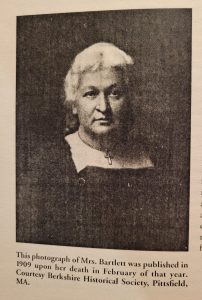
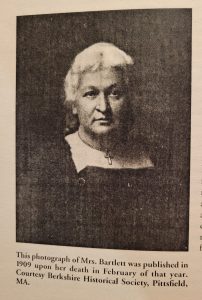
The historical trajectory of Mary Agnes Pomeroy (historically recorded as Agnes Pomeroy Bartlett) offers a profound case study in how 19th-century women operated as quiet emotional anchors and active estate administrators through the trauma of the American Civil War. While military histories fixate entirely on her husband—Major General William Francis Bartlett, famously the youngest general in the Union Army at age twenty-two—the primary diaries, letters, and business records reveal that Agnes was the foundational engine that kept his household and industrial ventures from collapsing. [1, 2, 3, 4, 5]
1. Elite Upbringing and Education
Mary Agnes Pomeroy was born on June 18, 1841, in Pittsfield, Berkshire County, Massachusetts, to Robert Pomeroyand Mary Center Jenkins. [2, 6]
- The Industrial Footprint: Her family belonged to the absolute socioeconomic elite of New England. Her father owned and operated massive, highly profitable industrial textile and iron manufacturing mills in the Berkshires.[2, 3, 7]
- The Academic Foundation: Because of her family’s wealth, Agnes was afforded an extraordinary level of education for a young woman of the pre-war era. She studied extensively at Miss Well’s School, attended the highly selective Pittsfield Young Ladies’ Institute, and was later sent to New York City to complete her advanced polishing and intellectual training. [2]
2. The General’s Silent Diary Muse
The Civil War completely upended her structured, upper-class world when it brought a heavily wounded, elite young officer swinging on crutches into the town of Pittsfield. [1]
William Francis Bartlett had suffered catastrophic injuries while leading troops: he lost his leg at the Siege of Yorktown, was shot through the arm and foot at Port Hudson, and was captured by Confederate forces at the Battle of the Crater, enduring brutal confinement in the notorious Libby Prison. [8]
                    [ THE WARTIME DIARY ECOSYSTEM ]
    William F. Bartlett (On Battlefield) ---> Writes Private Multi-Volume Journal
                                                     |
                                                     v [THE ENIGMATIC TARGET]
                                         "Agnes" (Identity Concealed)
                                                     |
                                                     v [THE COMPASSIONATE ANCHOR]
    Agnes Pomeroy (In Pittsfield) ----------> Receives & Responds via Secret Letters
Throughout his multi-volume wartime pocket diaries, Bartlett constantly wrote about a young woman he referred to simply and textually as “Agnes”. To protect her social standing from public scrutiny, her full identity as an industrial Pomeroy heiress was deliberately concealed by the general until the war officially concluded. Her private letters to him functioned as his primary psychological lifeline; during his dark months of recovery from successive amputations and prison-camp diseases, her correspondence was the anchor that kept him tethered to civilian life. [1, 2, 9]
3. Marriage and the Transition to Corporate Management
Following the Union victory, Bartlett recovered in Boston and formally became engaged to Agnes. They were married in a major high-society ceremony in Pittsfield on October 14, 1865. [4, 6, 10, 11]
Following a grand honeymoon tour of Europe, President Andrew Johnson awarded Bartlett the honorary rank of Brevet Major General, and the couple permanently settled back in Pittsfield. The marriage, however, was not one of idle leisure. Agnes immediately integrated her husband into her family’s commercial empire: [10]
- The Iron Master: Leveraging his new matrimonial ties, General Bartlett was appointed the Treasurer and General Manager of the Pomeroy Iron Works in West Stockbridge, Massachusetts, as well as managing extensive secondary iron manufacturing foundries down in Virginia. [3, 12]
- The Domestic Reality: While her husband held the public titles, Agnes managed the daily reality of a husband dealing with chronic, agonizing physical disability. She successfully managed their grand home and raised six children: Agnes, Caroline, Edwin, Robert, William, and Edith. [2, 3, 9, 10, 11]
4. The Trials of Widowhood: 11 Years of Marriage
The lingering infections, bullet fragments, and chronic gastrointestinal illnesses Bartlett contracted in Libby Prison eventually broke his body down completely. By September 1876, the war was systematically killing her husband before her eyes. [9]
Agnes’s journals from this era shift into a meticulous medical log. She recorded his failing appetite, his extreme physical weakness, and the various experimental treatments prescribed by their doctors. Proving her extraordinary internal resilience, Agnes gave birth to their final child, Edith, at the exact same time her husband became permanently bedridden; the general passed away on December 17, 1876, leaving Agnes a widow at just 35 years old.[3, 9]
                [ THE GENERATIONAL SURVIVAL ]
    1876: Death of General Bartlett ---> Leaves Agnes a Widow at Age 35
                                                |
                                                v [THE SYSTEMIC NETWORKS]
    Civil War Veterans / Army Companions ----> Step forward to insulate estate
                                                |
                                                v [THE MATRIARCHAL TRIUMPH]
    Agnes Pomeroy Bartlett ------------> Successfully raises 6 children alone
                                         Dies peacefully in 1909 at Age 67
Following his passing, Agnes proved that the bonds formed on the battlefields extended directly to the postwar home front. High-ranking Union veterans and Bartlett’s former military companions stepped forward to form a protective wall around her household, assisting her in managing her remaining financial shares in the Pomeroy industrial estates.[1]
Agnes never remarried. She dedicated the remaining 33 years of her life to historical preservation, ensuring her husband’s sacrifice was recognized by overseeing the erection of the major Civil War Soldier’s Monument in Pittsfield. She passed away peacefully from pneumonia on February 16, 1909, at the age of 67, and was laid to rest alongside her husband in Pittsfield Cemetery—a final, permanent monument to an exceptional woman who steered an elite family through the crucible of America’s bloodiest century. [3, 6, 7, 9, 12]
The Bartlett Double-Take
- Agnes’s Husband: Major General William Francis Bartlett (1840–1876) was a thoroughly Massachusetts-born Union hero from Haverhill and Pittsfield. [1]
- The Newfoundland Legend: The name Bartlett is arguably one of the most iconic surnames in Newfoundland history because of Captain Robert Abram “Bob” Bartlett (1875–1946), the legendary Arctic explorer who was born in Brigus, Newfoundland. Captain Bob famously commanded Robert Peary’s ship during the expedition to the North Pole. [1, 2, 3, 4]
While the Massachusetts general and the Newfoundland sea captain shared the same surname, they belonged to completely separate branches of the transatlantic Bartlett diaspora.
The Poetic Irony
In a striking historical coincidence, the American poet John Greenleaf Whittier actually unified these two worlds in a famous commemorative poem he wrote about Agnes’s husband, titled William Francis Bartlett. In the text, Whittier uses a literary device describing children playing on a beach with a “shaggy dog of Newfoundland,” accidentally linking the General’s name to the Canadian province forever in print! [1]
References and Bibliography
- Emerging Civil War Archives. (2022). Agnes Pomeroy Bartlett: The Young Woman in the General’s Diary & The General’s Wife and Widow. Emerging Civil War Biographical Series, Data Logs. [2, 3, 9, 13]
- Palfrey, Francis Winthrop. (1878). Memoir of William Francis Bartlett. Boston: Houghton, Osgood and Company. (The primary definitive text containing the extracted diary entries, wartime letters, and domestic records of Agnes Pomeroy’s household).
- Massachusetts Vital Records Project. (1909). Civil Death Registrations: Mary Agnes Pomeroy Bartlett, Record No. 534. Pittsfield Municipal Archives, Berkshire County, MA. [6]
- Pomeroy, Albert Alonzo. (1912). History and Genealogy of the Pomeroy Family: New England Branches. Volume 1. Toledo, Ohio: The Franklin Printing Co. (Provides the exact industrial asset mappings for Robert Pomeroy’s mills and the inheritance structures passed down to Agnes). [3, 4]
Leave a Reply