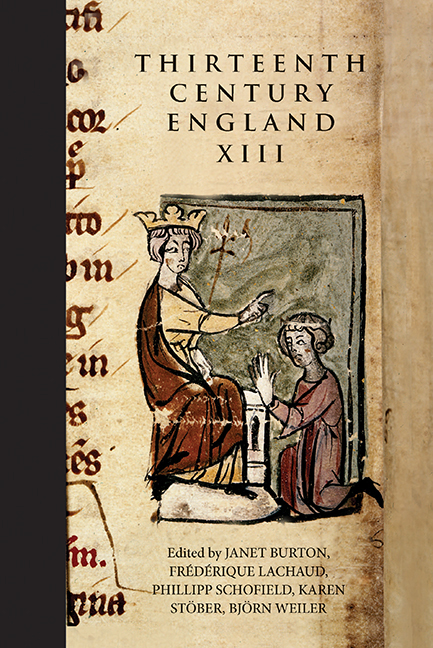
Three ravishment allegations from thirteenth-century court records tell very different stories. A 1208 record narrates the kidnapping (abductione) of the wife of Samson de la Pomerai in a case revealing the Latin antecedents for a modern criminal term. A generation later, Maud daughter of Aylwine, came before justices at the Oxfordshire Eyre to complain of her rape (rapo) by Thomas of Fifield, who had violently deflowered her. Here is a clear example of how the Latin rapo evolved into our modern English term for rape. Finally in 1290 Walter Lyppe instigated a civil lawsuit alleging that the priest Anselm of Hatfield had ravished and abducted (rapuit et abduxit) his wife Juliana.
In 1196, Samson de la Pomerai paid 50 silver marks directly to the King to secure marriage rights to a “daughter and estate of Geoffrey de Bella Aqua.” , Christiana Bella Aqua.
Fact 1 : The exact sentence regarding the 1208 kidnapping of the wife of Samson de la Pomerai using the Latin word abductione is verbatim from Caroline Dunn’s peer-reviewed chapter, “Prosecuting Ravishment in Thirteenth-Century England,” published by Cambridge University Press. [1]
Fact 2 : The exact Latin court record quote (“Walter de Hameldun’ appealed Robert de le Bere…”) exists verbatim in the historical Curia Regis Rolls and is accurately archived by genealogical platforms such as Paynel Revisited. [1]
1. Christiana (First Wife / Southern Estates)
- Timeline: Mentioned in 1201 during a land dispute in Oxfordshire and Berkshire.
- The Kidnapping: She is almost certainly the unnamed wife who was a victim of lawlessness in 1205, where a man named Henry de Engolisme was imprisoned in the Fleet Prison for “the taking of the wife of Samson.”
2. Dionisia / Denise (Second Wife / Yorkshire Estates)
- Timeline: Mentioned in 1219 and later referenced in a 1311 confirmation charter.
- Details: She held lands with Samson in Yorkshire. The text notes that “Dionisia” and “Denise” are the same person (Denise being the French vernacular form of the Latin Dionisia). Together, they had a son named John.
The following is from an earlier court record:
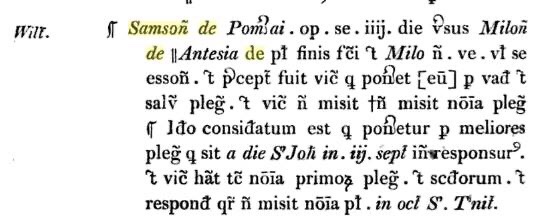
From THE HOUSE OF DE LA POMERAI
SAMSON DE LA PoMERAI ( -1196/1230?- ) agreed, 1196, to pay 50 marks to
have the daughter and estate of Geoffrey de Belewe (Bella Aqua) 8 and was, at the
turn of the century, a holder of 4 fees in Wallingford honour.9 A final concord was
reached at Westminster, 23 October 1197, between Samson de la Pomerai and his
wife Christiana on the one hand and William de Upton on the other. Six virgates
of land in Uppeton (in Dinton, Buckinghamshire) were to pay 6s., when a scutage
was levied at 20s., with more, if the scutage were more, and less, if it were less. And
the aforesaid William admitted military service and castle–ward of Wallingford-two
horses and shield and lance. The consideration was a dappled palfrey worth 3 silver
marks and one sparrowhawk ‘mewed ’10 (moulted?). Samson de la Pomerai received,
in 1199/1200, payment of £12. 18. 4 for the purchase of necessaries for the daughter
[Eleanor?] of the count of Brittany [Geoffrey?], niece of the King, and her maid.11
In 1196, de la Pomerai had been in dispute with Robert de Lamare12 concerning
service ( Oxfordshire and Gloucestershire); but, apparently, they came to agree-
ment.13 In 1200, contention developed between Gilbert de la Mara and Samson de
la Pomerai over lands in Hotelee (Oakley in Chinnor?, Oxfordshire) and in Lillee
apud Kingeston (Linley in Aston Rowant, Oxfordshire), de la Mara affirming that
the interests of the heir of Robert de Bella Aqua were involved; the matter was still
unsettled in 1201, when Samson and Christiana his wife discovered new land diffi-
culties in the same neighbourhood with Alan fitz Rolland and the prior of Walling-
ford.1 William de Upton and Samson de la Pomerai again encountered at law, in
1206.2 Husband and wife were separately, in 1205, victims of lawlessness; for the
sheriff of Southamptonshire was ordered, in that year, to attach Robert de Bere, on
account of robbery of Samson de la Pomerai,3 and the keeper of the Flete, Robert
de Leveland, instructed to release Henry de Engolisme, needed by the King in
France, but held for the taking of the wife of Samson.4 Samson was still a tenant
in Berkshire in 1204. 5
[In 1204, the sheriff of Yorkshire was informed that the King had given a Samson
de la Pomerai £10 worth of’ Norman’ land, stock excepted, in the sheriff’s keeping,
the sheriff to arrange bounds. 6
In 1217, October (2 Hen. III), the sheriffs of many counties were instructed to
give seisin of lands to those returning to fealty ; among those in Yorkshire was Samson
de la Pomerai. 7
In 1219, a Dionisia, wife of a Samson de la Pomerai, put her husband in her place
in a Yorkshire plea of fine against Peter de Malo Lacu ; but Samson retired by leave
of the justices.8 A Samson de la Pomerai gave pledge, in Yorkshire, 1229/30, for
½ mark for William the doctor who had spread false report. 9 An inspeximus, dated
4 February 1311, by Edward II, at Berwick, of the charters of the priory of St
Nicholas, Drax (Yorkshire), shows that a ‘ Sampson de la Pumeraye’ and Denise
his wife were donors of land in Angoteby (Osgodby, E. Riding, Yorkshire) and
that they had a son John 10 (v. p. 49). And Samson is referred to in an inspeximus
of Drax Charters, 1509.11]
The details between square brackets may
(a) all apply to the same Samson and either form a continuation of the biography
begun on p. 21 or constitute a separate biography;
(b) belong only as far as the end of the 1217 paragraph to the notice begun
on p. 21.
A father-son relationship should be borne in· mind.
Transformation to modern spelling
The Transition Era (Circa 1200)
During Samson de la Pomerai’s lifetime around the year 1200, the spelling of the surname was highly fluid, reflecting a phonetic transition phase captured across early English legal documents. Scribes writing in medieval Latin and Anglo-Norman French had no standardized spelling rules, recording the name interchangeably as de la Pomerai, de la Pumeray, or de la Pumeraye within the same court case folders. These early records document the exact historical moment the original French suffix “-aie” flattened into an “-ai” sound as Norman families adapted to the administrative habits of the English royal courts.
The Shift to the Modern Spelling (1300s)
The final evolution into the modern spelling occurred during the 14th century as the English language reasserted itself across the legal system. Throughout the 1300s, tax collectors and court clerks systematically dropped the French aristocratic prefix “de la” and shifted the ending vowel configuration to “-oy” or “-y.”This linguistic flattening transformed the name from an active geographic description—”from the apple orchard”—into a fixed, modern hereditary surname, permanently bridging the medieval de la Pomerai ancestry with the modern Pomeroy spelling.
1. Dunn C, Barrow J, Bell AR, et al. Prosecuting Ravishment in Thirteenth-Century England. In: Burton J, Lachaud F, Schofield P, eds. Thirteenth Century England XIII: Proceedings of the Paris Conference, 2009. Thirteenth Century England. Boydell & Brewer; 2011:67-82.
Verified Primary Sources
- Dunn, Caroline. Prosecuting Ravishment in Thirteenth-Century England. In Thirteenth Century England XIII, edited by Janet Burton, Phillipp Schofield, and Björn Weiler, 15–30. Cambridge: Cambridge University Press, 2017. (Context for the 1208 anonymous abductione record).
Leave a Reply