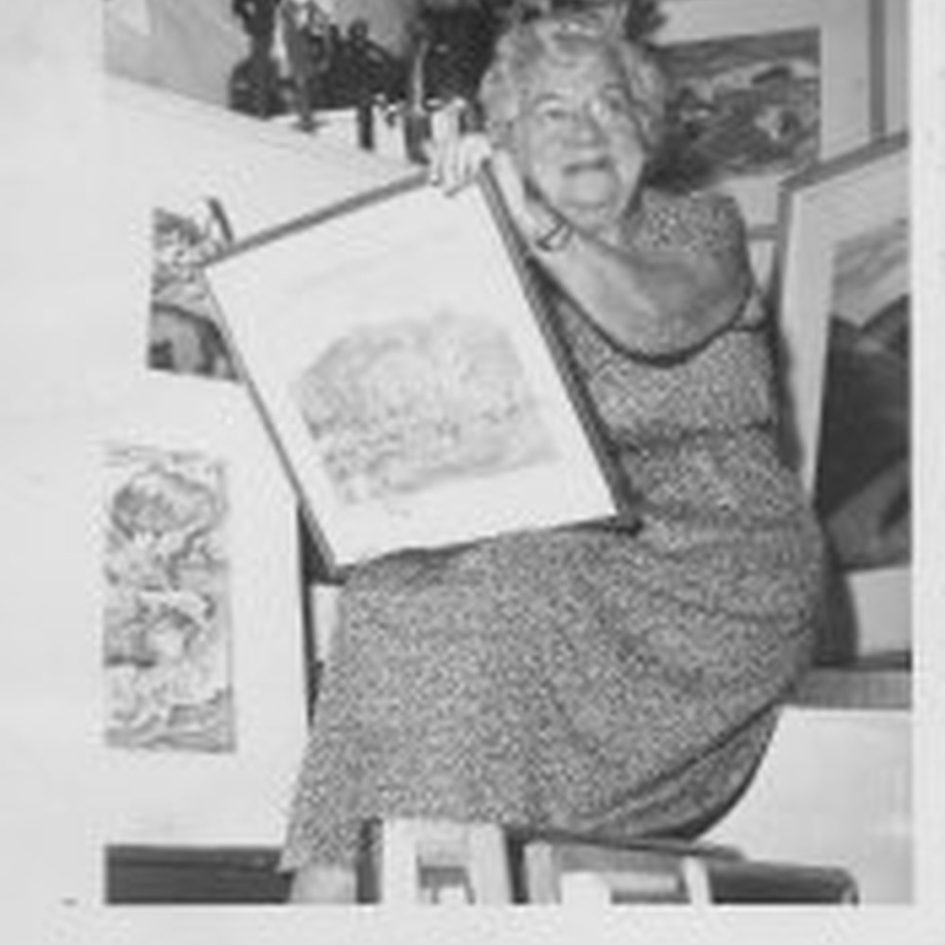
Elsie Lower Pomeroy (1882–1971) was an American painter and botanical illustrator whose career successfully bridged the worlds of meticulous scientific documentation and fine art landscape painting. Born in New Castle, Pennsylvania, she began her formal artistic training at the Corcoran School of Art in Washington, D.C. Her early professional work was defined by her employment with the United States Department of Agriculture (USDA) during the opening decades of the twentieth century, where she served as one of a small, select group of botanical illustrators. In this role, she contributed extensively to the USDA Pomological Watercolor Collection, producing highly accurate, detailed watercolor illustrations of diverse fruit varietals to assist agricultural scientists and growers with classification. In 1911, she married Carl Stone Pomeroy, adopting the surname under which she would establish her legacy in the fine art community.

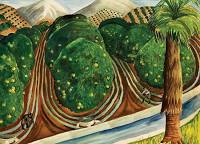
As her artistic practice evolved, Pomeroy moved beyond scientific illustration to engage directly with the American Scene Painting movement, specializing in California Regionalism. To expand her technical versatility, she sought instruction from several of the most influential figures of the California Water Color Society, studying under Phil Dike, Eliot O’Hara, and the renowned regionalist painter Millard Sheets. This advanced training allowed her to master rhythmic abstraction and apply it to large-scale narrative landscapes. Her expertise in agricultural subjects culminated in 1937 with a celebrated five-part watercolor series focused entirely on the Southern California citrus industry. These pieces critically explored both the labor conditions and structural dangers of industrial orange cultivation, such as the use of smudge pots to mitigate frost damage, while simultaneously highlighting the economic importance of the regional harvest.
Pomeroy relocated to Northern California during the early 1940s, settling in Mill Valley, where she resided and painted for nearly three decades. Her work was widely exhibited at premier national institutions, including the National Gallery of Art, the Art Institute of Chicago, the Oakland Art Gallery, and the 1939 Golden Gate International Exposition. She maintained active memberships in prominent organizations such as the California Water Color Society and the San Francisco Women Artists group, earning multiple exhibition prizes throughout her career. Pomeroy moved from Mill Valley in 1969 and passed away two years later in 1971. Her artwork remains an essential historical record of mid-century California life and agricultural development.

Bibliography
- Artprice. The Biography of Elsie Lower POMEROY. Historical auction data and artist index documenting her birth city, educational background, and comprehensive exhibition history. Source URL.
- Calisphere (University of California). Elsie Lower Pomeroy Holding One of Her Art Pieces, c. 1960s. Digital archive entry from the Mill Valley Public Library confirming her residency timeline from the 1940s to 1969 and her dual focus on USDA illustration and California Scene Painting. Source URL.
- Official Estate of Elsie Lower Pomeroy. New Article on Elsie Lower Pomeroy’s Citrus Paintings! Published research analysis detailing the two distinct phases of her career, her 1911 marriage, and the structural composition of her 1937 Southern California citrus watercolor series. Source URL.
- Wikipedia. Elsie Lower Pomeroy. Biographical entry detailing her lifecycle dates, association with the American Scene Painting movement, and her role within the United States Department of Agriculture. Source URL.
Leave a Reply