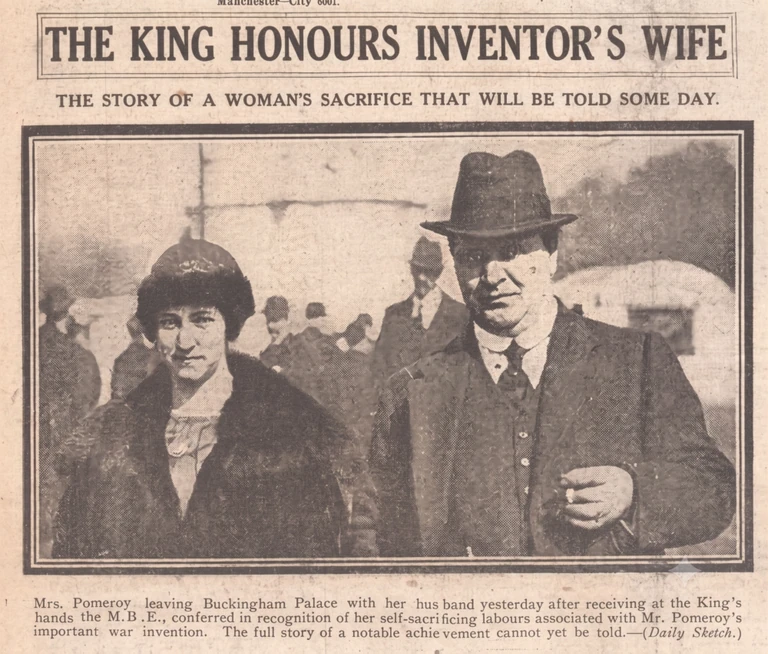
John Pomeroy was born on August 17, 1873, in Invercargill, New Zealand, the son of James Henry Pomeroy and Louisa Mary Jane Brokenshaw. He was a prolific inventor characterized by a “defiantly amateur style,” valuing raw intuition over conventional engineering advice and often showing far more concern for generating ideas than marketing them . On April 14, 1903, he married Mary McDonald in Invercargill.
His most significant contribution occurred during World War I with the invention of the Pomeroy explosive bullet. Standard copper-jacketed machine-gun rounds typically passed completely through the outer fabric layers and hydrogen gas bags of German Zeppelins without causing catastrophic damage. Pomeroy’s design featured a standard .303 caliber round loaded with a tube containing a stabilized explosive mixture. Upon striking the outer envelope of a Zeppelin, the minimal resistance of the fabric triggered an immediate detonation, ripping holes in the structure and igniting the escaping hydrogen gas .
After initially facing skepticism and rejections from military bureaus, the British Royal Flying Corps officially adopted the munition as the Cartridge S.A. Ball .303 inch Pomeroy Mark I in 1916 . The widespread deployment of Pomeroy bullets by home defence pilots successfully destroyed multiple invading airships, causing a sharp decline in German aerial raids over the United Kingdom. For his work, the British government awarded him approximately £25,000 in royalties e.
Throughout his life, Pomeroy held dozens of diverse patents across agricultural and mechanical fields. He successfully secured international patents for practical items, including a specialized hat-fastener and a pneumatic horse-collar, which featured localized internal air bladders to maximize the physical comfort of working draft animals.
In 1937, Pomeroy attempted to pitch a newly designed anti-aircraft incendiary shell to the Australian army. Following a flat rejection by domestic authorities, he sold these explosive bullet variations to both China and the United States. In his later years, he aggressively claimed that the American military used essential features of his design to manufacture their successful .50-caliber “blue-nose” shells during the Pacific War, though his legal petition demanding £5 million in back royalties was rejected by the U.S. government .
It was during the late 1930s that his focus shifted to more speculative, experimental concepts, culminating in his widely publicized “death ray.” Pomeroy claimed he had successfully isolated a specific energy frequency that would prove immediately fatal to human flesh and capable of instantly disabling enemy aircraft. On September 1, 1938, newspapers across Australasia ran sensationalized headlines declaring that his deadly ray had successfully destroyed aircraft in trials. Driven by these theoretical designs, Pomeroy actually traveled to China during the Second Sino-Japanese War, hoping to sell the weapon to Chiang Kai-shek’s Nationalist government as an anti-aircraft shield against Japanese warplanes. In reality, the weapon never materialized into functioning military hardware. While his explosive ammunition was highly effective, contemporary military scientists dismissed his energy weapon blueprints as pure mechanical fantasy.
To secure a steadier income, Pomeroy moved to Melbourne, Victoria, during the early 1920s . He managed a few local hotels, but became a famous city landmark by establishing a mobile night-stall outside Flinders Street station known as “Pop’s Pie Cart” . Drawn by a white horse, the cart was a nightly hub where Pomeroy—described as plump, round-faced, and silver-haired—would personally lower the wooden counter flaps to sell pies, pasties, coffee, steak and kidney on toast, and a unique dish known as a “floater” (a meat pie served in a bowl of soup) until the early hours of the morning .
John Pomeroy died of cancer in South Melbourne on August 21, 1950, at the age of 77, having spent his final months attempting to formulate a self-taught cure for his illness . He was survived by two daughters from his first marriage, and a daughter and two sons from his second marriage.
Bibliography
- Australian Dictionary of Biography. Pomeroy, John (1873–1950). Volume 11, Melbourne University Press, 1988. ADB Profile Entry.
- National Library of New Zealand. Exploding cows, baby killers and death rays. History Archives. National Library Post.
- Imperial War Museums. Boxed set of experimental .303 caliber Pomeroy explosive projectiles. System Index Record ID: 30027529.
Leave a Reply