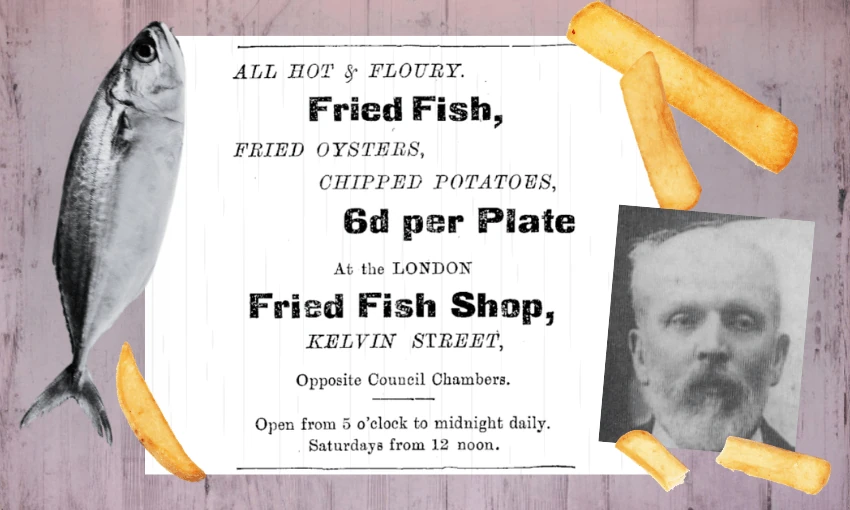

The origin of New Zealand’s most iconic meal—hot fish and chips—does not belong to a vague tradition, but to the specific operational decisions of a Cornish immigrant named James Henry Pomeroy. Born in Falmouth, England, in 1853, Pomeroy was trained as a ship’s carpenter before seeking a new life in the southern hemisphere. He arrived in Wellington aboard the passenger ship Bebington in 1872 and eventually pushed further south to the frontier town of Invercargill. It was here that he transitioned from the maritime trades into the seafood industry, founding the firm Pomeroy & Sons.
By the late 19th century, his business had evolved into a massive regional network. Pomeroy did not just sell fish; he commanded a commercial fleet that harvested Blue Cod from the freezing, turbulent depths of the Foveaux Strait and Stewart Island. This was a critical strategic choice. The lean, tight muscle fibers of cold-water Blue Cod made it uniquely capable of withstandng high-heat deep-frying without absorbing excess oil, a quality that set the standard for what would become the South Island’s culinary signature.
The definitive shift in New Zealand’s dining habits occurred in May 1903. While hotels had previously served pan-fried fish as part of sit-down meals, Pomeroy established the country’s first dedicated, standalone takeaway shop: the London Fried Fish Shop. Located at 31 Kelvin Street, directly across from the Provincial Council Chambers, the shop was a marvel of imported technology. Pomeroy had arranged the complex logistics to bring specialized commercial stoves and high-heat deep-frying appliances directly from the United Kingdom. Local reports at the time were fascinated by the “special stove,” noting its ability to cook both fish and “chipped potatoes” with a speed and thoroughness never before seen in the colony.
However, Pomeroy was as combative as he was innovative. The historical record shows a man who was frequently at odds with local authorities and conservation laws. In 1905, his shop was fined for the illegal sale of protected freshwater trout. In 1906, his son Charles was prosecuted for poaching fish during the closed season. The family’s defiance of the state reached a peak in 1909 when Pomeroy’s grandson, Robert, was sentenced to a juvenile training farm. When the state failed to release the boy on the exact day his sentence ended, James Henry Pomeroy successfully sued the government for a writ of habeas corpus to secure his immediate release.
Pomeroy eventually retired to Melbourne, Australia, where he passed away on February 20, 1930. He was buried in the Healesville Cemetery, leaving behind a legacy that was carried on by his son, John. While James had mastered the commercial fryer, John became a globally recognized inventor. John’s most significant contribution to history was the “Pomeroy explosive bullet,” which was officially adopted by the British Royal Flying Corps during World War I and used to bring down German Zeppelins. From the first deep fryer in Invercargill to the defense of the British skies, the Pomeroy family’s impact was defined by a refusal to follow the status quo.

Bibliography
- The Spinoff. The man who brought fish and chips to New Zealand. Published June 21, 2026. The Spinoff Archive.
- National Library of New Zealand. The Inventions of John Pomeroy. Official History Blog. National Library Post.
- Australian Dictionary of Biography. Pomeroy, John (1873–1950). Volume 11, Melbourne University Press. ADB Online.
- The Southland Times. New Enterprise: The London Fried Fish Shop. Archive Issue, May 1903.
Leave a Reply