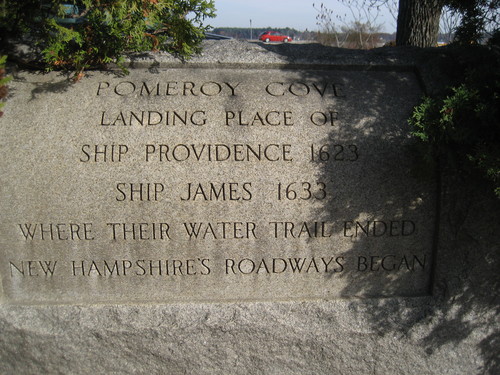
The establishment of permanent European settlement in New Hampshire is structurally tied to the deep-water access points of the Pascataqua region. In the spring of 1623, Edward Hilton, William Hilton, Thomas Roberts, and a small company of colonists initiated the first enduring settlement in the territory at a strategic point of land later designated as Hilton Point. This landfall was entirely dependent on transatlantic commercial backing, which was provided by Leonard Pomery, or Pomeroy, a wealthy and influential merchant operating out of Plymouth, England.

Location: 50 Boston Harbor Road
N 43°07.517’ E070°50.185’
Pomeroy served as the primary financial investor for Edward Hilton’s exploratory and mercantile expedition. He owned the ship Providence, the vessel utilized to transport the Hilton colonists across the Atlantic. Historical records indicate that Pomeroy, acting as a manager of early New England land speculation, likely accompanied the colonists on this inaugural voyage in 1623.
Upon arrival, the Providence navigated the local riverways to find a secure landing site, anchoring at a natural cove along the shoreline. This specific anchorage was the only highly viable landing location along that stretch of the riverfront. In recognition of the expedition’s financier, the settlers named the geographic feature “Pomeroy Cove”. This landing occurred approximately two and a half years after the 1620 arrival of the Pilgrims at Plymouth Rock.
The early settlement pattern unfolded rapidly around this maritime gateway. While Edward Hilton established initial operations, William Hilton’s family initially joined the separate Plymouth Colony in 1624 before migrating north to join the permanent settlement at Hilton Point. For the first decade of its existence, the population and infrastructure of the nascent colony remained strictly concentrated on the narrow strip of land situated between the point and Pomeroy Cove, where the inhabitants focused their industry on trading with local indigenous populations and fishing the tidewaters. In later centuries, the physical geography of the cove was significantly altered, being split into halves by the construction of the Dover & Portsmouth railroad line.
Brigus Newfoundland is directly linked to the very dawn of permanent English colonization on the continent:
- The Foundation: In 1610—a decade before the Pilgrims reached Plymouth—an English explorer named John Guy established Canada’s first official English colony at neighbouring Cupids Cove.
- The Expansion: Shortly after landing, Guy and his fellow English “planters” expanded their footprint along Conception Bay, establishing permanent fishing plantations at Brigus.
Key Historical Highlights
Today, the Brigus Historical Zone functions as a picturesque municipal heritage district famed for preserving its 18th- and 19th-century architecture:
- The Brigus Tunnel: A famous 30-meter passage blasted completely through solid coastal rock by a Cornish miner in 1860 using gunpowder, built specifically so sailing captains could easily unload cargo without hauling it over a steep ridge.
- Hawthorne Cottage: The historic home of Captain Bob Bartlett, universally celebrated as the greatest Arctic ice navigator of the 20th century. He famously commanded the ship that guided Robert Peary’s expedition close to the North Pole in 1909.
- Landfall Cottage: A rustic coastal dwelling dating back to 1786 that later served as the home and studio for the legendary American artist Rockwell Kent.
European settlements in North America predated Pomeroy Cove by many years:

St. Augustine, Florida (1565): Established by the Spanish, this is the oldest continuously occupied European-established city in the continental United States.

Tadoussac, Quebec (1600) & Port-Royal, Nova Scotia (1605): Established by the French, these represent the earliest permanent French colonial settlements north of the Gulf of Mexico.

Jamestown, Virginia (1607): The first permanent English settlement in North America, predating Pomeroy Cove by 16 years.

Santa Fe, New Mexico (1610): Established as a primary seat of Spanish colonial power in the American Southwest.

Plymouth, Massachusetts (1620): The famous landing of the Pilgrims on the Mayflower occurred nearly three years prior to the settlement at Pomeroy Cove.
Bibliography
- Dover Public Library Archive: Historical Sketch, Views and Business Directory of Dover, N.H., Originally presented by Dover Grange No. 225, 1926; preserved by the City of Dover Digital History Collection.
- Historical Records: Early registries tracking the Squamscott Patent, the ship Providence, and the 1623 Plymouth merchant rosters.
Leave a Reply