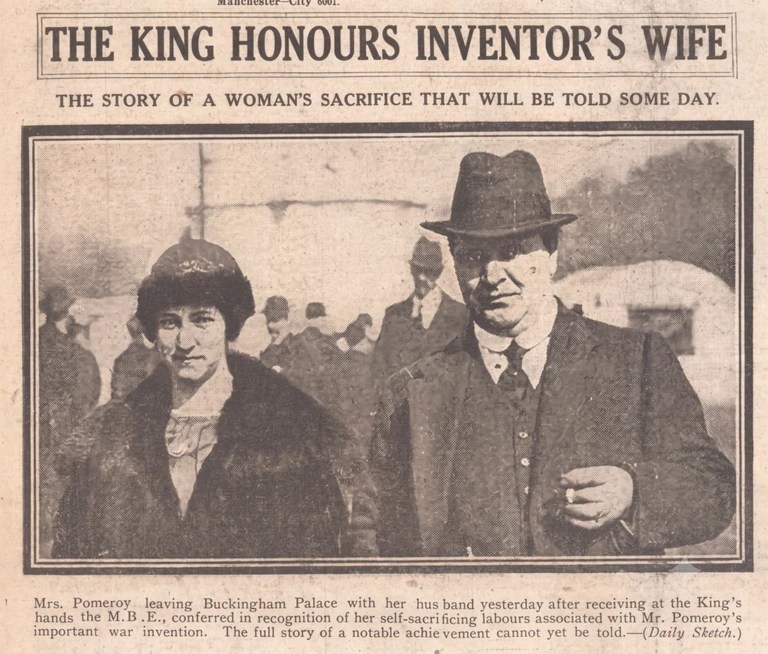

A striking window into the hidden logistics of World War I air defense is captured in the March 21, 1918, front-page photographic feature of the British newspaper, the Daily Sketch. The clipping records the exact moment that Amy Amelia Pomeroy walked out of Buckingham Palace alongside her husband, John. She had just been officially invested as a Member of the Most Excellent Order of the British Empire (M.B.E.) by King George V. Her royal appointment serves as a permanent, public acknowledgment of a civilian woman whose direct domestic support and personal risks facilitated a major shift in British air defense.
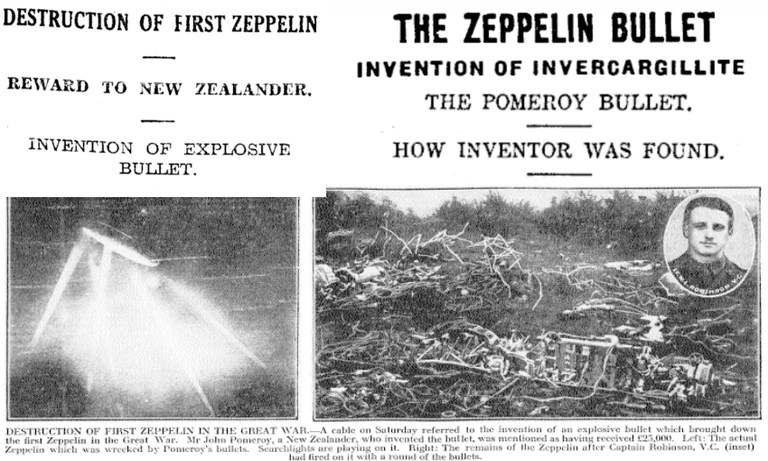
Born Amy Amelia Blom in Victoria, Australia, in 1891, she married the self-taught New Zealand inventor John Pomeroy in Melbourne on September 11, 1911. Her husband was a prolific designer who had formulated the blueprints for a specialized explosive .303 caliber machine-gun round. While standard ammunition passed cleanly through the outer canvas envelopes of invading German Zeppelins without causing damage, Pomeroy’s cartridge incorporated a highly shock-sensitive explosive mixture designed to detonate upon the slightest structural impact. Facing repeated skepticism from local colonial military bureaus, the family made the high-stakes decision to travel directly to Londonduring the height of the war to lobby the British War Office.
Upon their arrival in Great Britain, the Pomeroys faced immediate institutional hurdles. Before the government would authorize an official manufacturing contract, military testing inspectors demanded immediate, uniform prototype batches for live-fire examination. Operating independently without corporate capital or access to an official manufacturing plant, the family prepared these volatile sample cartridges manually within their private, temporary lodging quarters. Amy Amelia Pomeroy stepped directly into this hazardous environment, providing meticulous physical labor to handle and assemble the experimental rounds alongside her husband.
The exact, day-to-day technical steps and precise quantitative volume of the cartridges handled by Amy Amelia were treated with strict wartime confidentiality. However, her actions were widely noted in contemporary newspaper archives as an immense display of bravery and domestic sacrifice. The contemporary press reported that she directly assisted her husband with his work under dangerous domestic conditions, explicitly noting that she had risked her life day after day and night after night handling and assembling the high-risk, experimental ammunition components in their private quarters.
Her steadfast support ensured the timely delivery of the uniform testing batches that ultimately triumphed at the live-fire military trials, leading to the official adoption of the design in August 1916 under the designation of the Cartridge S.A. Ball .303 inch Pomeroy Mark I. When widely distributed to the home defense squadrons of the Royal Flying Corps, the Pomeroy bullet completely broke the back of the German strategic bombing campaign, enabling pilots to ignite escaping hydrogen gas and down the massive airships over the mainland. Recognizing that the success of this weapon was fundamentally tied to the high-risk efforts undertaken in the inventor’s flat, the British Crown formally gazetted her appointment to the M.B.E. on January 1, 1918. Her citation stands as a permanent public record, honoring her “self-sacrificing labours associated with Mr. Pomeroy’s important war invention.”

Leave a Reply