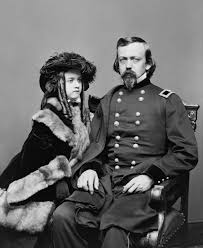
General Charles Pomeroy Stone (1824–1887) received the middle name Pomeroy from his mother’s family, explicitly honoring his maternal uncle by marriage, Colonel William Pomeroy [Pomeroy, 1912].
The Naming Origin and Family Alliance
Charles Pomeroy Stone was born on September 30, 1824, in Greenfield, Massachusetts. He was one of ten children born to Dr. Alpheus Fletcher Stone, a prominent town physician, and his wife, Fanny Lincoln Cushing.
The name “Pomeroy” was introduced into his immediate branch of the family tree through his mother’s elder sister, Christiana Thaxter Cushing. In 1819, Christiana married Colonel William Pomeroy (1776–1842), a well-known resident, merchant, and insurance executive in the local Franklin and Hampshire County area. William Pomeroy was a direct descendant of the foundational New England Pomeroy line [Pomeroy, 1912].
When Charles was born five years later in 1824, his parents chose to give him the middle name “Pomeroy” to honor this close family alliance and his influential uncle [Pomeroy, 1912]. This practice of cross-generational naming ran deep within their family circle; his aunt and uncle, Christiana and William Pomeroy, conversely chose to name one of their own children William Pomeroy Cushing to tightly bind the identities of the respective family lines. This ancestral middle name stayed with Charles throughout his notable life, spanning his graduation from West Point, his service as a general in the Civil War, his transformation into “Stone Pasha” as the head of the Egyptian Army, and his final historic civilian role as the Chief Engineer responsible for constructing the pedestal of the Statue of Liberty.
The military career and life transitions of General Charles Pomeroy Stone (1824–1887) are detailed in prose below, expanding upon his battlefield commands, his political imprisonment, and his global engineering achievements.

Early Military Exploits and the West Point Foundation
Charles Pomeroy Stone began his path to national prominence at the United States Military Academy at West Point, graduating seventh in the highly competitive class of 1845. Commissioned directly into the Ordnance Corps, his early tactical capabilities were quickly tested during the Mexican-American War. Serving under Major General Winfield Scott’s army, Stone fought with distinction across major campaigns, earning two separate brevet promotions to First Lieutenant and Captain for his bravery on the battlefield. Following the war, he spent five years serving as the Chief of Ordnance for the Pacific Department before temporarily resigning from active military service in 1856 to pursue banking and to survey vast tracts of land for the Mexican government in Sonora.
The Civil War, Ball’s Bluff, and McCarthy-Era Scapegoating
With the outbreak of the American Civil War approaching, Stone rushed back to Washington, D.C., where on January 1, 1861, he became widely recognized as the very first volunteer officer officially mustered into the Union Army. Appointed Inspector General of the District of Columbia militia, he successfully secured the capital city and guarded President-elect Abraham Lincoln during his high-risk first inauguration. Promoted to Brigadier General of Volunteers in August 1861, Stone was placed in command of the Corps of Observation along the upper Potomac River.
His career suffered a catastrophic political blow following the disastrous Union defeat at the Battle of Ball’s Bluff on October 21, 1861. Though Stone had granted his field commander, Colonel Edward Baker, full operational discretion, Baker was killed and the Union troops were routed. Seeking a public scapegoat for the loss, the Joint Committee on the Conduct of the War—driven by radical abolitionists who already distrusted Stone for his strict adherence to federal laws regarding the return of fugitive slaves—targeted the general. On February 8, 1862, Stone was arrested in the middle of the night on unsubstantiated suspicions of treason. He was arbitrarily imprisoned without official charges or a trial for 189 days at Fort Lafayette. Though later fully cleared of wrongdoing and restored to service as Chief of Staff for the Department of the Gulf, the political smear permanently cost him any major combat command for the remainder of the war, prompting his resignation in September 1864.

Global Legacy: “Stone Pasha” and the Statue of Liberty
Seeking to rebuild his professional standing after the war, Stone looked abroad. In 1870, he accepted a commission from the Khedive of Egypt, eventually rising to become a Lieutenant-General and Chief of Staff for the Egyptian Army. Known internationally as Stone Pasha, he spent over a decade completely reorganizing, modernizing, and expanding the Egyptian military apparatus, mapping uncharted African territories, and establishing specialized schools for the children of soldiers.
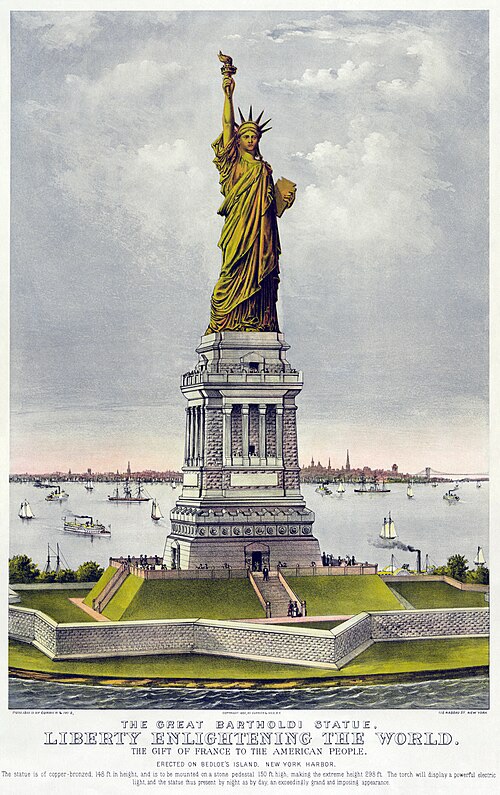
Upon returning to the United States, his reputation as an extraordinary organizer and civil engineer led to his appointment as the Chief Engineer for the Statue of Liberty pedestal project from 1883 to 1885. Stone meticulously directed the construction workforce on Bedloe’s Island, overseeing the arrival of massive iron and copper shipments from France and engineering the deep structural anchor system required to bolt Frédéric-Auguste Bartholdi’s colossal monument to its stone base. His structural work proved so sound that contemporary critics noted the entire island would have to be overturned to dislodge the statue. Stone died of pneumonia on January 24, 1887, just months after the monument’s grand inauguration, and was buried with full military honors at West Point.
Bibliography
- Cushing, James S. The Genealogy of the Cushing Family: An Account of the Ancestors and Descendants of Matthew Cushing. Montreal: The Perrault Printing Co., 1905. (Documents the household marriage alliances connecting the Stone, Cushing, and Pomeroy branches).
- Lamb, Blaine. The Extraordinary Life of Charles Pomeroy Stone: Soldier, Surveyor, Pasha, Engineer. Bloomington: Indiana University Press, 2016. (Provides a comprehensive biographical account detailing his West Point training, the political mechanics of his Civil War imprisonment, his modernization of the Egyptian military, and his final engineering role at Bedloe’s Island).
- National Park Service. General Charles Pomeroy Stone – Statue Of Liberty National Monument. Washington, D.C.: U.S. Department of the Interior. (Verifies his logistical and structural engineering accomplishments as Chief Engineer for the monument’s pedestal from 1883 to 1885).
- Wikipedia. Charles Pomeroy Stone. (Chronologically compiles his timeline from his 1824 birth to his 1887 death, tracking his brevet promotions in Mexico and his volunteer status in the Union Army).
- FamilySearch Historical Records. Brigadier General Charles Pomeroy Stone (1824–1887) Life History. Salt Lake City: The Church of Jesus Christ of Latter-day Saints. Verifies the exact, vetted parentage under Dr. Alpheus Fletcher Stone and Fanny Lincoln Cushing, alongside his Massachusetts birth registry records.
- Pomeroy, Albert Alonzo. History and Genealogy of the Pomeroy Family: Collateral Lines in Family Groups. Shadows the complete tree of the American Pomeroy family, documenting Colonel William Pomeroy’s 1819 marriage to Christiana Cushing and his naming influence on his nephew, Charles Pomeroy Stone.
- Wikipedia. Charles Pomeroy Stone. Establishes his parentage to the town doctor in Greenfield, his Puritan descent, and his dual career as a U.S. Army Officer and modern civil engineer.
I
Leave a Reply