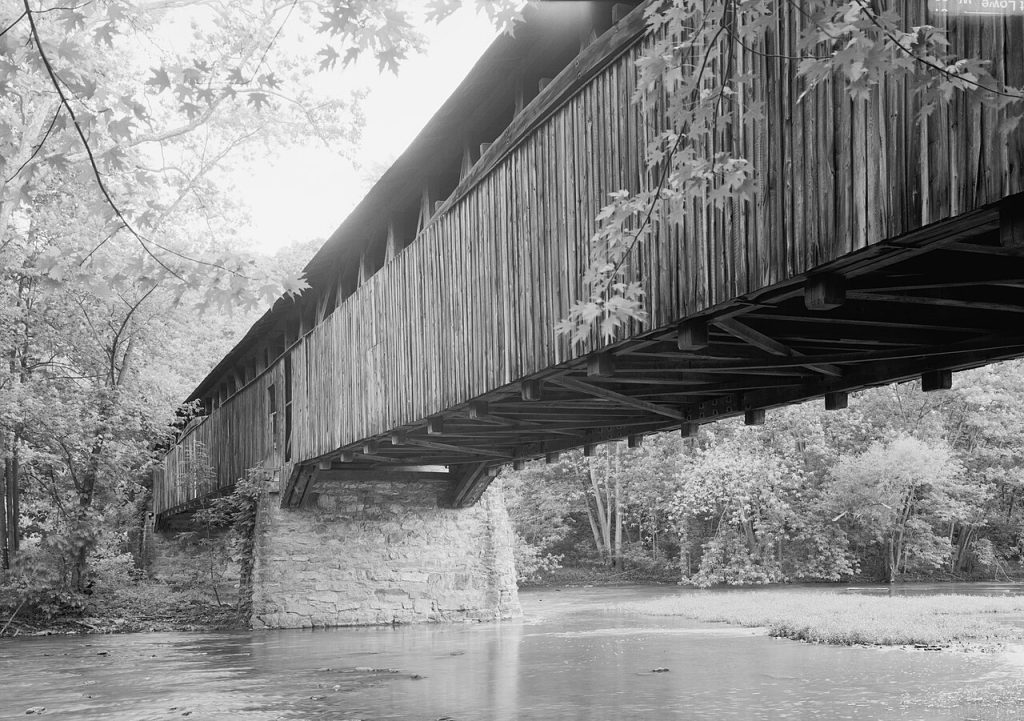
The Pomeroy-Academia Covered Bridge stands today as a monumental achievement in early twentieth-century wooden engineering, spanning the waters of Tuscarora Creek in Juniata County, Pennsylvania. Holding the record as the longest remaining covered bridge in the Commonwealth of Pennsylvania, the structure measures an impressive 278 feet in length. The bridge derives its compound title from two distinct historical anchors: the nearby village of Academia—home to the historic Tuscarora Academy—and Joseph Pomeroy, a prominent local merchant whose industrial and commercial footprint dominated the regional economy throughout the mid-to-late nineteenth century.
The Enterprise of Joseph Pomeroy
To understand the critical economic importance of the bridge’s location, one must trace the career of Joseph Pomeroy (1804–1874), a pioneer entrepreneur who effectively transformed the Spruce Hill and Beale township borders into a bustling center of rural trade. Born in Pennsylvania, Pomeroy moved to the area as a young man and established a sweeping merchant empire. He opened a massive general merchandise store that became the primary supply hub for surrounding farmsteads, and he expanded his operations by constructing a large, water-powered merchant flour mill and a saw mill along the active currents of Tuscarora Creek.
Pomeroy’s leadership extended far beyond simple shopkeeping. He successfully dammed a portion of the creek to channel water into his mills, turning the site into the industrial heart of the valley. Recognizing that transportation was the lifeblood of commerce, Pomeroy was a chief promoter of regional infrastructure. He served as a major investor and director for the local Tuscarora Valley Railroad and championed the construction of early public roads. Because his massive flour mill sat on the northern bank of the creek, local farmers living on the southern side faced a perilous water crossing to bring him their grain. To secure his supply chain and assist his customers, Pomeroy lobbied county commissioners to establish a reliable crossing at his mill dam, which resulted in the erection of a timber bridge at the coordinates in 1870. Beyond his business ventures, Pomeroy was a deeply civic-minded individual, serving as an associate judge for Juniata County and acting as a primary financial benefactor for the nearby Tuscarora Academy, ensuring local youth had access to higher education.
The 1901 Disaster and the Burr Arch Innovation
The original infrastructure built during Joseph Pomeroy’s lifetime survived for three decades, but it was ultimately destroyed by environmental forces. In March 1901, following a brutal winter, a sudden and rapid atmospheric warming trend swept across Pennsylvania, causing massive snowpacks to melt instantly. This triggered a catastrophic ice jam along Tuscarora Creek. Huge, shifting sheets of thick ice rushed down the river channel, battering the wooden supports of the 1870 bridge, rendering it structurally unsafe, and forcing county officials to permanently seal the crossing.
The loss of the bridge isolated local populations, cutting off farmers from the mill and preventing residents from traveling across the creek to attend religious services and academic classes in Academia. Recognizing the urgent need for a permanent, flood-resistant solution, the Juniata County Commissioners authorized a heavy-duty replacement project in 1901. They awarded the construction contract to a highly respected regional builder named James N. Groninger for a total cost of $6,484.
Completed in 1902, Groninger’s surviving structure is a masterclass in the double-span Burr Arch Truss design. Developed and patented in 1804 by the acclaimed American inventor Theodore Burr, this specialized engineering system integrated massive, curved wooden arches directly into a rigid geometric truss framework. By anchoring the heavy timber arches deep into stone abutments on the riverbanks and a central stone pier in the middle of the creek, Groninger was able to distribute the weight of the massive 278-foot span evenly, eliminating the need for vulnerable intermediate supports inside the active flood channels.
Preservation and Modern Legacy
The Pomeroy-Academia Bridge functioned as a heavily traveled component of the local highway network for exactly sixty years, enduring the transition from horse-drawn wagons to heavy automotive transport. By 1962, the structural demands of modern commercial trucking forced the state to route vehicular traffic onto a modern concrete bypass built downstream, slating the old timber bridge for total demolition.
Recognizing its immense architectural and historical value, the Juniata County Historical Society intervened. They purchased the vacant landmark from the county for the symbolic price of a single dollar, saving it from the wrecking crew and successfully securing its listing on the National Register of Historic Places in 1979.
By the turn of the twenty-first century, time and weather had severely rotted the roof shingles and floorboards. Between 2001 and 2009, the historical society partnered with the Pennsylvania Keystone Recreation, Park and Conservation Fund to execute a massive, $1.4 million professional restoration. Specialized timber-wrights carefully jacked up the entire 278-foot structure, replaced rotted structural chords with historically accurate white oak and hemlock timbers, and restored the exterior vertical siding and shingle roof. Today, the fully stabilized bridge is preserved as a pedestrian-only historic park. It stands as a testament to the industrial vision of Joseph Pomeroy and the enduring brilliance of early American craftsmanship, welcoming travelers from across the continent to walk through its historic timber interior from sunrise to sunset.
Bibliography
- The National Heritage Protection Registry:
- National Register of Historic Places. “Academia Pomeroy Covered Bridge – Reference #79002241.” Washington, D.C.: Heritage Conservation and Recreation Service, United States Department of the Interior [NPGallery Digital Archive].
- Joseph Pomeroy Biographical & Industrial Records:
- Juniata County Historical Society. “The Merchant of Spruce Hill: The Business Ledgers and Civic Contributions of Judge Joseph Pomeroy (1804-1874).” Mifflintown, PA: JCHS Biographical Monograph Series.
- Jones, J. Simpson. History of the Early Settlers of the Juniata Valley: Embodying an Account of the Early Pioneers and the Industrial Foundations of Calhoun and Pomeroy Mills. Harrisburg, PA: Pennsylvania Archives Press, 1889.
- The 1901 Flood and Structural Replacement Contract:
- The Juniata Tribune. “The Destruction and Condemnation of the Pomeroy Mill Bridge Following the Severe Ice Jams of March 1901.” Mifflintown, PA: Historical Archive Print Series, April 11, 1901.
- Juniata County Commissioners Ledger. “Contract Specifications and Financial Appropriations for the Construction of the New Academia Bridge by James N. Groninger (January 1902 Minutes).” State Historical Society of Pennsylvania.
- The State Restoration and Structural Financing:
- Pennsylvania Department of Conservation and Natural Resources. “Keystone Recreation, Park and Conservation Fund Structural Success Stories: The Structural Rehabilitation of the Pomeroy-Academia Covered Bridge.” Harrisburg, PA: Government Project Registry Series.
Leave a Reply