Historical biography is often buried beneath layers of ancestral folklore and family myths. When we strip away later genealogists’ embellishments and focus exclusively on surviving 13th-century archival rolls, a clear portrait emerges of Samson de la Pomerai (also recorded as Sampson de la Pumeraye), a minor Anglo-Norman knight whose life spanned major structural and geographic transitions in medieval England [G005175.pdf].
Identity and the Untraceable Lineage
Samson operated during the chaotic reigns of King Richard I (the Lionheart) and King John [G005175.pdf]. In academic family studies, he is classified as a “scion” of the house—a younger son descending from a minor, unrecorded branch rather than the primary baronial line residing at Berry Pomeroy Castle in Devonshire [G005175.pdf].
Because he was not a premier tenant-in-chief, royal inheritance audits (Inquisitions Post Mortem) were never drawn up for his immediate birth line [G005175.pdf]. Consequently, his direct biological father, grandfather, and great-grandfather remain completely unknown to history.
Phase I: Southern Estates and the First Marriage
Samson’s early adult career was rooted in the southern counties of Buckinghamshire and Oxfordshire, where his properties fell under the administrative jurisdiction of the Honour of Wallingford.
- The 1196 Crown Accord: To establish his initial estate, royal records note that Samson agreed to pay a substantial fine of 50 marks to King Richard I to secure the lands and heirs of Geoffrey de Belewe.
- Marriage to Christiana: Samson’s first historically verified wife was Christiana [G005175.pdf].
- The 1197 Property Settlement: On October 23, 1197, a formal property agreement (Feet of Fines) was executed at Westminster [G005175.pdf]. The document records a land dispute settlement between Samson, Christiana, and a man named William de Upton over six virgates of land in Upton, Buckinghamshire [G005175.pdf].
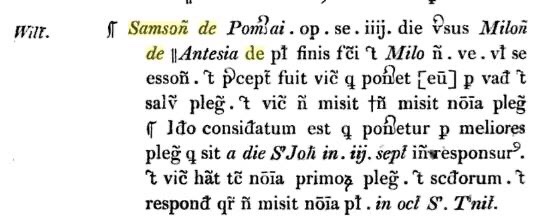
- The Case of Miles de Antesia: Between 1199 and 1201, the Curia Regis Rolls reveal that Samson was actively pursuing a civil contract lawsuit against Miles de Antesia (Milon de Antesia) for breaching a land fine (de placito finis facti). Miles failed to appear in court, prompting the judges to penalize the local Sheriff for failing to secure adequate financial bonds (sureties) to enforce his attendance.
The Abduction Dispute in Context
A common point of confusion in the Pomeroy tree is a criminal case recorded in the Rotuli Curiae Regis between 1198 and 1202 involving Samson’s household.
In her book Prosecuting Ravishment in Thirteenth-Century England, historian Caroline Dunn highlights how medieval legal terminology differs from modern definitions. In 13th-century common law, abductione (or ravishment) was primarily treated as a severe property crime—the physical carrying off of a noblewoman to forcibly control her dowry, inheritance, or land assets.
The original entry records that a prosecutor named Walter de Hameldun brought a criminal appeal against Robert de le Bere for executing a property raid and “abducting the wife of Samson de la Pomerai” (Christiana). When Hameldun failed to follow up on the prosecution, Samson de la Pomerai and Robertus de Falaise stepped forward as financial bondsmen (securities for prosecution) to pay the remaining court fees and legally close the matter.
Phase II: The Northern Relocation and Second Marriage
Following the death of his first wife, Samson executed a complete geographic shift to the north of England, driven entirely by marital and financial strategy [G005175.pdf].
- Marriage to Denise (Dyonesia) Paynel: Samson entered into his second marriage with Denise (written in Latin as Dionisia or Dyonesia), the daughter and sole heir of Jordan de Angoteby (Osgodby) [G005175.pdf].
- The Manor of Osgodby: Through Denise’s lineage, Samson assumed management of a lucrative northern estate in the Manor of Osgodby, Yorkshire [G005175.pdf].
- The Monastic Charters: The real chartularies of Drax Priory preserve the physical proof of their northern life. The surviving text records a joint charter where “Sampson de la Pumeraye and Denise his wife” granted a local tenement and ten acres of land in a field called Lambecroft to the church of St. Nicholas at Drax.
- The Heir and Continuity: The Drax charters confirm the couple had a son and heir named John de la Pomerai, who eventually succeeded to the Osgodby properties [G005175.pdf].
- The 1246 Royal Survey: The long-term tenure of their estate is verified by a 1246 Crown assessment tracking landholders across Yorkshire. The assessors explicitly recorded that “Dyonisia and Samson” were still actively holding their fees in Osgodby as tenants under the premier regional baron Peter de Mauley and his wife, Isabel de Turnham.
Bibliography & Source Material
- Dunn, Caroline. Prosecuting Ravishment in Thirteenth-Century England. Published in Thirteenth Century England XIII, edited by Janet Burton, Frédérique Lachaud, and Phillipp Schofield. Cambridge: Cambridge University Press, 2017.
- Powley, Edward B. The House of de la Pomerai: Annals of the Family. Liverpool: University Press of Liverpool, 1944 [G005175.pdf].
- Public Record Office. Curia Regis Rolls: Preserved in the Public Record Office (Reigns of Richard I and John). London: His Majesty’s Stationery Office.
- Yorkshire Archaeological Society. Yorkshire Fines (1218–1231). Record Series, Volume 54. Leeds: Printed for the Society.
Leave a Reply